

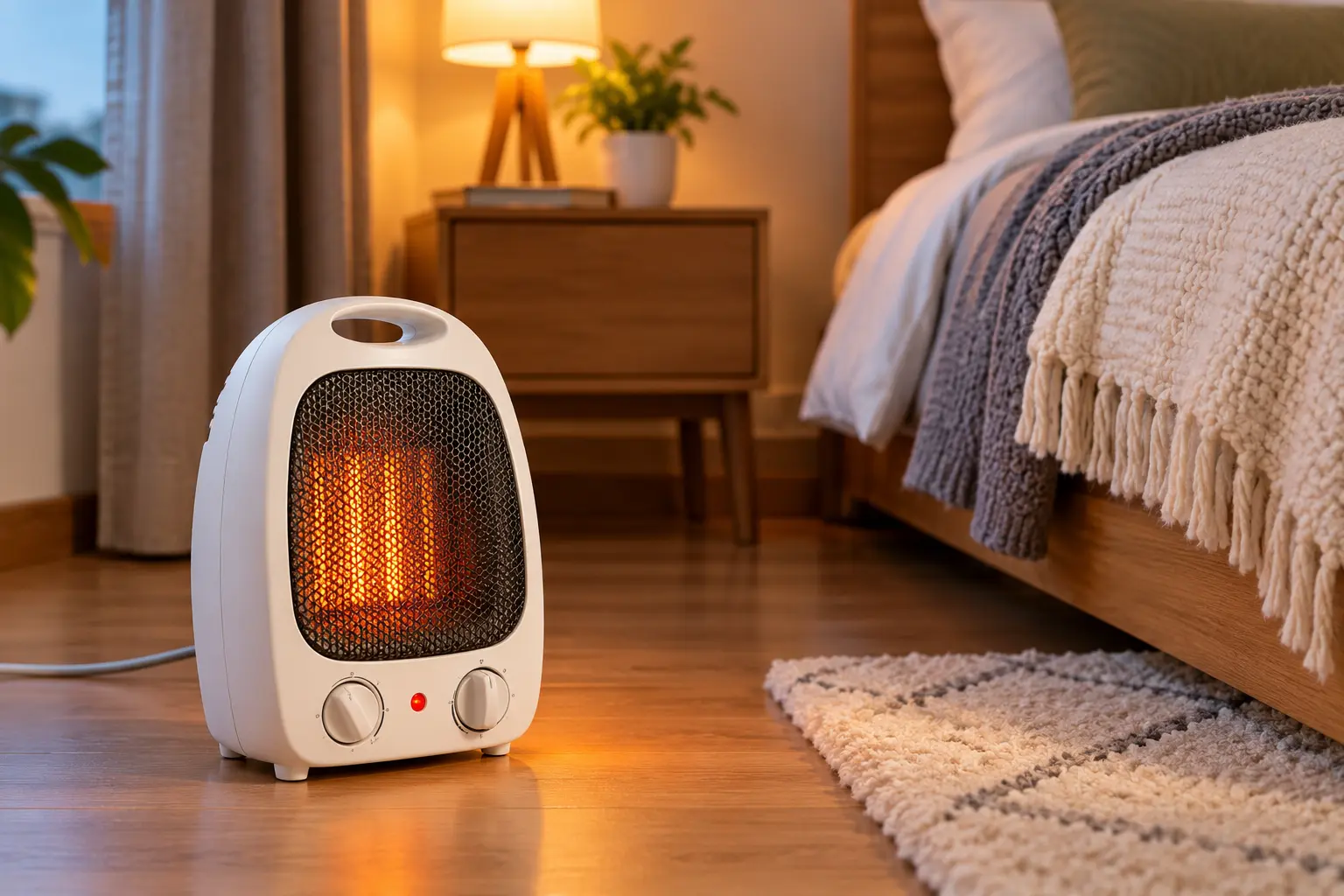
If you want the best room heater under 2000, the hard part is not finding one. It is avoiding a heater that is too weak for your room or unsafe to leave running. Most models in this budget are 1000W to 2000W fan, halogen or quartz heaters, and the type matters more than the brand name. This article explains each type in simple words, shows how to pick the right wattage, lists the safety checks that matter, and compares four models for Indian homes. It also covers what a heater really costs to run and when you are better off buying something else.
How this article was researched: We have not tested these heaters ourselves. The picks come from manufacturer and retailer specification pages, a Government e Marketplace listing, BIS standard information and a consumer safety column in The Tribune. Where a detail could not be confirmed, the article says so.
What is the best room heater under 2000?
For most Indian homes, a 2000W fan heater (also sold as a convector) with two heat settings, overheat protection and a visible ISI mark is the best room heater under 2000. It warms a small bedroom quickly and costs little to buy. If you want silent heat aimed at one person, a halogen or quartz radiant heater suits better. Skip any heater that has no ISI mark.
Here is the reasoning. A fan heater pushes hot air around, so a small closed room feels warm within minutes. The two heat settings (usually 1000W and 2000W) let you drop to low power once the room is comfortable. The trade offs are fan noise and drier air. At this price you are buying a spot heater for a bedroom or study, not something that will warm a big hall.
Our view (opinion, not a tested result): treat a 2000W heater as suitable for a room of roughly 100 to 150 square feet. Some seller listings claim up to 250 square feet for 2000W models, but that looks like a best case figure for mild cold, so do not rely on it for a Delhi or Punjab winter night.
Quick comparison of heater types
| Type | Best for | Room size (rule of thumb) | Power use | Safety | Main drawback |
|---|---|---|---|---|---|
| Fan heater or convector | Warming a whole small room | Up to about 150 sq ft | Usually 1000W and 2000W settings | Enclosed grille, but body and air get hot | Fan noise, dry air |
| Halogen | Directed heat for one or two people | Spot heating only | Often 1000W to 2000W | Exposed glowing tube, keep away from children | Heat reaches only what is in front of it |
| Quartz or radiant | Quiet heat near a desk or bed side | Spot heating only | Budget models often 400W to 1000W, some 2000W | Exposed glowing tubes | Weak for a full room |
| Oil filled | Long, steady, quiet heating | Up to 150 to 200 sq ft | Commonly 1500W to 2500W | Surface stays cooler, no glow | Rarely available under ₹2,000 |
Types of room heaters explained
Fan heater (blower or convector). A heating element warms the air and a fan pushes it into the room. Shops often call these blowers. Bajaj sells its Majesty RX10 as a heat convector, and a Government e Marketplace listing also describes it as a convector with a fan. Labels vary: one price site calls the same RX10 a halogen heater, so go by the maker’s own description.
Halogen heater. A halogen tube glows and sends out radiant heat, like a small sun. You feel warmth on your body quickly, even if the room air is still cold. Move away from the heater and the warmth drops.
Quartz or radiant heater. It works on the same idea as halogen, with quartz tubes that glow. It is usually silent and often lower in wattage, which makes it a spot heater.
Oil filled heater. Sealed oil inside fins is heated and the fins release warmth slowly. It is quiet, does not glow and dries the air less. In the listings checked for this article, oil filled models sat above ₹2,000 (for example, a Havells Pacifio Mica on a Bajaj Finserv price page), so this type is not a realistic pick for this budget.
How to choose a room heater under 2000
- Measure your room. A small bedroom of about 100 to 120 square feet is a good match for a 2000W fan heater. For a smaller room or a desk, 1000W may be enough.
- Pick the wattage. Choose a heater with two settings, 1000W and 2000W, so you are not stuck on full power. Bajaj Finserv’s buying information also suggests 1000W to 1500W for small to medium rooms and 2000W for larger ones.
- Check safety features. Look for overheat protection (a thermal cutout), a tip over switch, a front grille on fan models and an ISI mark. More on this in the next section.
- Think about noise. Fan heaters hum. If you light sleep, a radiant heater is quieter, but it only heats what faces it.
- Look for a thermostat. An adjustable thermostat switches the element off when the room reaches your chosen temperature, which helps comfort and can cut running time at full power.
- Read the warranty and service details. Budget heaters usually carry one or two years. Listings sometimes disagree on this, so check the final product page and keep the invoice.
- Check the power load at home. A 2000W heater draws roughly 8.7 amps (2000 watts divided by 230 volts). That is more than a 6A socket is meant to carry. Use a 16A socket if you have one, or ask an electrician. Remember that other appliances on the same line add to the load.
Safety checks before buying and using
- Overheat protection. This cuts power if the heater gets too hot. It should be listed in the specifications, not just in a seller’s description.
- Tip over switch. It switches the heater off if it falls. This matters in homes with children, pets or small rooms where things get knocked.
- ISI or BIS mark. Room heaters fall under the Indian safety standard IS 302 (Part 2/Sec 30). A consumer column in The Tribune notes that room heaters cannot be sold without the mandatory ISI mark. Look for the mark on the product and the box.
- Distance from curtains, bedding and furniture. Keep a clear gap on all sides. This is general safety advice (editorial), and it matters most with exposed element heaters such as halogen and quartz.
- Children and pets. Place the heater on a flat floor where it cannot be touched or pushed over. Never use it on a bed, sofa or carpet pile.
- Extension board risk. Plug the heater into a wall socket. Cheap extension boards are not built for 2000W of continuous load and can overheat.
- Never leave it on while sleeping or when you leave the room. A heater is safest when someone is awake and nearby. Switch it off before you go to bed.
The oxygen myth, explained honestly. Many people believe a room heater “burns oxygen.” That is true only for heaters that burn fuel, such as LPG, kerosene or coal. In a closed room these can use up oxygen and release carbon monoxide, which is the real danger, as consumer expert Pushpa Girimaji explains in The Tribune. An electric heater has no flame and burns nothing, so it does not consume oxygen. What people notice with fan heaters is dry, stuffy air. Opening a window slightly now and then is a good habit for comfort, but the oxygen scare does not apply to electric models.
How much electricity does a room heater use?
Use this formula:
Cost = (Watts x Hours) / 1000 x Tariff per unit
Example only: a 2000W heater running for 3 hours at a tariff of ₹7 per unit.
(2000 x 3) / 1000 = 6 units. 6 units x ₹7 = ₹42 per day. Over 30 days that is about ₹1,260.
On the 1000W setting, the same 3 hours uses 3 units, about ₹21. Electricity tariffs vary by state, by slab and by time of year, so check your own bill for the rate. A 2000W heater uses about 2 units for every hour at full power, as Bajaj Finserv’s 2000W heater information also states. A thermostat can lower real usage because the element switches off at intervals once the room is warm.
Product recommendations
These four models were picked because they fall in the budget range on retailer listings, offer 2000W, and show safety features in specifications. We could not open every brand’s own product page, so some details come from retailers and review sites. Treat them as a starting checklist and confirm on the Amazon listing.
A note on price. Prices for the same heater differ a lot between sellers and change with sales. Bajaj’s own store lists the Majesty RX10 at an MRP above ₹2,000, while marketplace deal pages in July 2026 showed lower selling prices. Check the current price on Amazon, as it changes often, and only buy if the final price is within your budget.
1. Orpat OEH-1260 Fan Room Heater
- Type: Fan heater
- Wattage: 2000W (dual heat settings of 1000W and 2000W, per a review site)
- Verified from listings: Overheat protection, tip over switch and a two metre power cord appear on a retailer product page. It is also listed as auto revolving.
- Advantages: Fast room warming, two power levels and a long cord that reaches a wall socket easily.
- Limitations: Listings disagree on warranty (some say one year, others two years), so confirm before buying. Like any fan heater it dries the air.
- Suits: A small bedroom or study, used for short periods.
Smart Choice

Orpat OEH-1260 2000-Watt Fan Heater (Grey)
Suitable for small rooms and personal use during cold winter days.
2000 Watts • Dual heat settings • 2 Year Warranty
2. Orpat OEH-1220 Fan Room Heater
- Type: Fan heater
- Wattage: 2000W, with 1000W and 2000W levels per a review site
- Verified from listings: A retailer page gives dimensions of about 22.5 x 11 x 21.5 cm, 230V, 50Hz and 2000W power use. Several price pages list a one year warranty.
- Advantages: Compact and light, so it moves easily between rooms.
- Limitations: The compact body means the heat reaches the area close to it more than the far corner. We could not confirm the full safety feature list from an official page, so check for overheat protection and an ISI mark on the listing.
- Suits: Tight budgets and spot heating at a desk or bedside.
Smart Choice
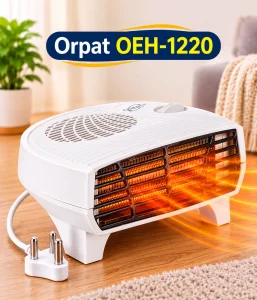
Orpat OEH-1220 2000-Watt Fan Heater (White)
Suitable for small to medium-sized rooms and people looking for quick heating with simple controls.
2000 Watts • Dual heat settings (1000W & 2000W) • 1-Year Warranty
3. Havells Bero Quartz Room Heater
- Type: Quartz room heater
- Wattage: 800W, with 400W and 800W settings
- Verified from sources: The product has two quartz heating tubes, a carry handle, a front safety grill, a tip-over switch and a rust-free stainless steel reflector. It comes with a 2-year product warranty. Price History+2
- Advantages: Two heat settings, portable design, tip-over safety switch and a stainless steel reflector.
- Limitations: Its 800W output is better suited to personal or close-range heating than heating a large room. It uses radiant heat rather than circulating warm air.
- Suits: Buyers looking for a compact quartz heater for personal use, a study area or a small space.
Smart Choice
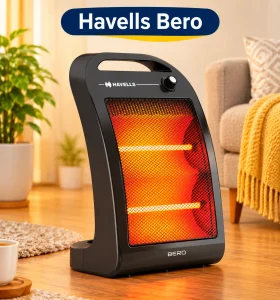
Havells Bero 800W Quartz Room Heater
Suitable for users who want a lightweight, portable heater with two quartz heating tubes for personal heating during winter.
800 Watts • Dual heat settings (400W/800W) • 2-Year Warranty
4. Bajaj Deluxe 2000W Halogen Room Heater
- Type: Halogen radiant heater
- Wattage: 2000W
- Verified from listings: A Bajaj Finserv listing describes a steel body, 2000W output and ISI approval.
- Advantages: Quick, directed warmth with no fan noise.
- Limitations: The glowing tube is exposed, so it needs extra care around children and fabrics. We could not confirm a tip over switch, thermostat or warranty from the sources found, so check these before buying. It warms people in front of it, not the whole room.
- Suits: One person sitting in front of it for a short time, for example while studying or working.
Smart Choice
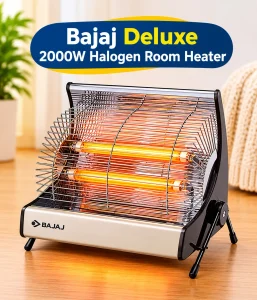
Bajaj Deluxe 2000W Halogen Room Heater
Suitable for users who need quick, direct heating for personal use or small rooms during winter.
2000 Watts • Dual heat settings (1000W/2000W) • 2-Year Warranty
Not included: The Havells Cista 2000W (a well reviewed type of fan heater) is shown on Havells’ own site at a price well above ₹2,000, so it does not fit this budget. Quartz heaters were left out because the wattage and safety details of budget models could not be confirmed from reliable pages.
Room heater vs other options
Water heating rod (immersion rod). It heats water in a bucket and cannot heat a room. If your real problem is cold bathing water, a geyser is the better fix, and geyser options under ₹10,000 are worth a look.
Blower heater. This is just another name for a fan heater, so the advice in this article applies to it.
Oil filled radiator. It is better for long evening use because it is quiet and holds steady heat. It costs more, and in the listings checked it was above ₹2,000.
AC heating mode. If you already own a split AC with a heat mode, it can deliver more warmth per unit of electricity than a resistance heater. Many Indian ACs are cooling only, so check your remote for a heat setting.
When a room heater is not the best choice: a large hall or open plan space, all night heating, homes with weak wiring or a 6A socket, rooms where you cannot supervise it, and very mild winters where a blanket and warm clothes are enough.
Common mistakes to avoid
- Buying on price alone and ignoring the ISI mark.
- Choosing 1000W for a room that needs more, then running it for hours without getting warm.
- Plugging a 2000W heater into a loose or overloaded extension board.
- Placing it near curtains, a bed or a pile of clothes.
- Sleeping with the heater on.
- Trusting a seller’s coverage claim (such as 250 sq ft) without checking your own room size.
- Ignoring warranty details when listings disagree.
- Assuming oil filled or halogen heaters are free of any risk. Every heater needs space and supervision.
Which room heater under 2000 should you buy?
The best room heater under 2000 is usually a 2000W fan heater with two settings, overheat protection and an ISI mark, such as the Orpat OEH-1260 or Bajaj Majesty RX10 if the price fits. Pick a halogen heater only if you want quiet, directed heat for one person. Whatever you choose, check the current price on Amazon, confirm the warranty on the final listing and never leave the heater on while you sleep.
Frequently asked questions
Does a room heater consume a lot of electricity?
Yes, compared with a fan or light. A 2000W heater uses about 2 units an hour at full power. At ₹7 per unit that is about ₹14 an hour, and your state’s tariff may be different.
Fan heater or halogen heater, which is safer?
A fan heater is generally easier to use safely because its element sits behind a grille and it can have a thermostat. A halogen heater has an exposed glowing tube. Either type is safer with overheat protection, a tip over switch and an ISI mark.
Can I run a room heater all night?
We do not recommend it. Heaters are safest when someone is awake and nearby. Warm the room before bed and switch the heater off. Use a blanket instead for the night.
How many watts do I need for a room?
A rough rule is 1000W for a very small room or a desk, and 2000W for a bedroom of about 100 to 150 square feet. Cold climates and poor insulation need more power or a different heating method.
Is it safe to use with an inverter?
Usually not. A 2000W heater is a heavy load for a standard home inverter and its battery, and the inverter may trip or drain quickly. Check your inverter’s capacity before connecting any heater.
Does a room heater reduce oxygen in the room?
Electric heaters do not burn oxygen. The oxygen and carbon monoxide risk comes from fuel burning heaters such as LPG, kerosene or coal. A fan heater may dry the air, so a little ventilation helps comfort.