

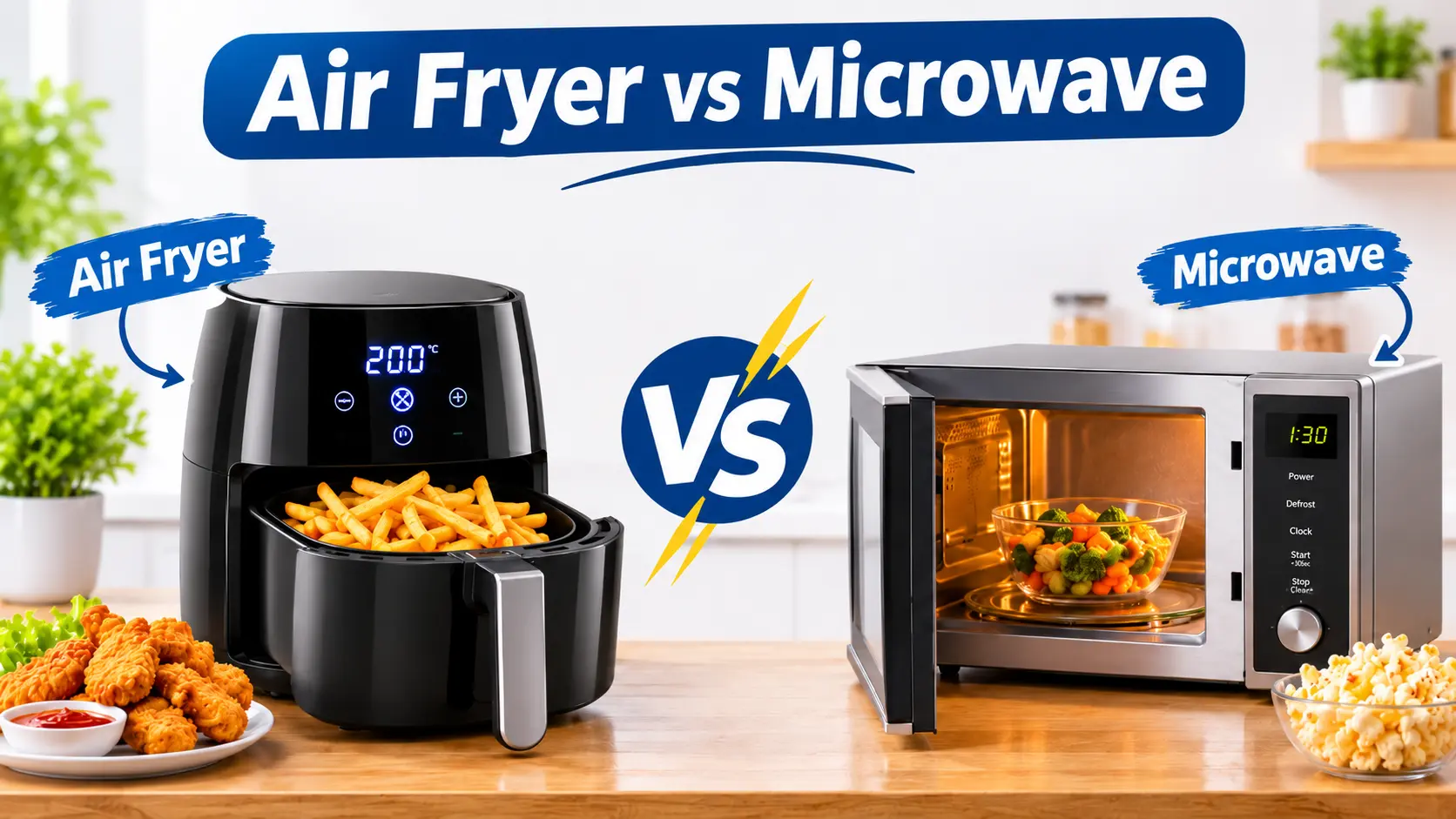
If most of your cooking is reheating dal, rice, sabzi and milk, get a microwave. If you mainly want crispy samosa, tikki, fries and tikka without deep frying, get an air fryer. If you can only afford one and your family loves snacks, a basic air fryer costs much less than a microwave, so it is the easier first buy.
Walk into any appliance store in India and you will hear the same question again and again: air fryer or microwave? Both sit on the counter, both look simple, and both promise to save time. The truth is that they cook in very different ways, so the right choice depends on what lands on your plate every day.
Air Fryer vs Microwave: Quick Comparison
| Feature | Air Fryer | Microwave Oven |
| Best at | Crisping, roasting, light frying | Reheating, defrosting, basic cooking |
| How it works | Fan moves hot air around the food | Microwaves heat the water inside food |
| Dal, rice, curry, milk | Slow, and gravies can dry out | Fast and even |
| Samosa, kachori, tikki, fries | Crisp results | Soft and chewy in solo models |
| Baking and grilling | Small batches only | Convection models bake cakes and grill tikka |
| Typical capacity | 2 L to 6 L | 20 L to 30 L |
| Oil needed | A teaspoon or less | None for heating |
| Cleaning | Wash basket and tray | Wipe cavity, wash turntable |
| Approx price in India | About 2,000 to ₹15,000 | About ₹4,500 to ₹20,000 |
Best Air Fryers to Consider
If crispy snacks are a regular demand in your home, these four air fryers are worth a look. All of them have a 4 L to 4.5 L basket, which is enough for a small or medium family, and they differ mainly in power, controls and warranty. Specifications and prices change from time to time, so check the exact model and the current price before you buy. Treat this as a shortlist rather than a tested ranking. If none of them suits you, you can browse more air fryers on Sopinggo.
iBELL AEROFRY422M 4.2 L Air Fryer
Smart Pick
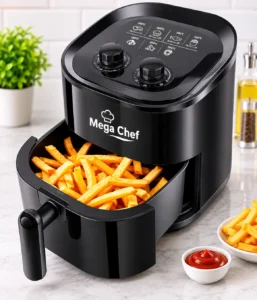
iBELL AeroFry 4.2L Air Fryer
Suitable for small to medium sized families looking for a convenient way to prepare crispy snacks and everyday meals with less oil.
4.2L Capacity • 1500W Power • Adjustable Temperature & Timer • 2 Year Warranty
The iBELL AeroFry 4.2L offers enough space for preparing snacks and everyday meals for small to medium-sized families. Its 1500W power, adjustable temperature settings and timer make cooking more convenient. The 2-year warranty is another useful benefit to consider when choosing an air fryer for regular home use.
Wonderchef Platinum 4.5L Digital Air Fryer – Features & Benefits
Smart Pick
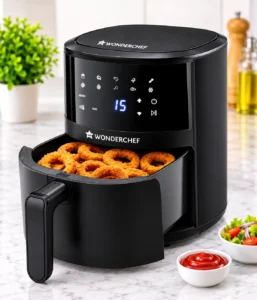
Wonderchef Platinum 4.5L Digital Air Fryer
Suitable for small to medium sized families looking for convenient cooking with multiple preset options and less oil.
4.5L Capacity • 1350W Power • 2-Year Warranty
A practical option for families looking to prepare crispy snacks, roasted vegetables and everyday meals with less oil. Its 4.5L basket provides room for family-sized portions, while the digital controls and preset cooking functions make meal preparation more convenient.
Faber 4L Digital Air Fryer – Features & Cooking Benefits
Smart Pick

Faber 4L Digital Air Fryer
Suitable for small families looking for a versatile air fryer for frying, baking, and roasting with less oil.
4L Capacity • 1350W Power • 2-Year Comprehensive Warranty
A convenient choice for small families who want to prepare crispy snacks, roasted vegetables and baked dishes with less oil. Its 4L capacity is suitable for everyday portions, while the digital controls make it easier to manage cooking time and temperature.
KENT Classic 4L Hot Air Fryer – Cooking Features & Benefits
Smart Pick
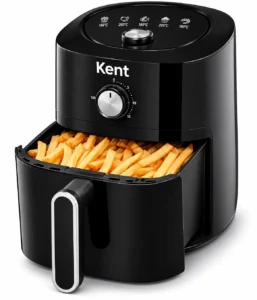
KENT Classic 4L Hot Air Fryer
Suitable for small families looking for a versatile appliance to fry, grill, roast, steam, and bake with less oil.
4L Capacity • 1300W Power • 1-Year Warranty
A useful option for small families who want to prepare crispy snacks, grilled dishes and roasted food with less oil. Its 4L capacity offers room for everyday portions, while the multiple cooking functions provide flexibility for preparing different recipes.
Best Microwave Ovens to Consider
If reheating, defrosting and family meals matter more to you, start with a microwave. These two models cover the most common needs: a simple solo oven for everyday heating and a convection oven that also bakes and grills. Models and prices change often, so check the current price and availability before you buy. If you want more choices, you can look through more microwave ovens in other sizes and types on Sopinggo.
iBELL 25L OTG Oven – Baking, Grilling & Toasting Features
The iBELL 25L OTG Oven is a suitable option for families who enjoy preparing homemade cakes, pizzas, grilled snacks and roasted dishes. Its 25L capacity provides enough room for small to medium-sized cooking portions, making it useful for regular home baking and occasional grilling. The 1600W power helps with different cooking tasks, while its OTG design offers more flexibility than a basic toaster. It can be a practical addition to your kitchen if you want to try different baking and roasting recipes at home without investing in a larger oven.
Smart Pick
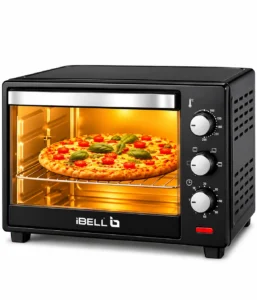
iBELL 25L Electric OTG Oven
Suitable for small to medium sized families looking for an appliance to bake, grill, toast, and prepare roasted dishes at home.
25L Capacity • 1600W Power • 2 Year Warranty
Panasonic 25L Solo Microwave Oven – Everyday Cooking & Convenience
A practical choice for small to medium-sized families who need a reliable appliance for everyday kitchen tasks. Its 25L capacity provides enough room for heating meals, warming milk, defrosting frozen food and preparing simple dishes. The solo microwave design focuses on essential cooking functions, while automatic cooking options make food preparation more convenient. It is a suitable option for households that mainly need quick reheating and basic cooking rather than baking or grilling.
Smart Pick
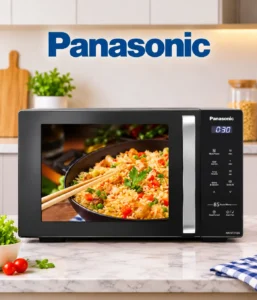
Panasonic 25L Solo Microwave Oven
Suitable for small to medium sized families looking for convenient everyday cooking, reheating, and defrosting with automatic cooking options.
25L Capacity • Solo Microwave • 1 Year Warranty
What Is an Air Fryer and How Does It Work?
An air fryer is a small countertop oven with a very strong fan. A heating element warms the air, and the fan pushes that hot air around the food at high speed. The surface dries out and turns crisp, which gives you a fried texture without sitting the food in oil.
In Indian kitchens it usually handles samosa, aloo tikki, paneer tikka, chicken tikka, french fries and frozen snacks. For fresh things like potato wedges or marinated paneer, a teaspoon of oil is normally enough.
Where it helps: crisp snacks with far less oil than a kadhai, quick cooking for small batches, and good roasting for vegetables and tikka. Where it struggles: the basket is small, so a big family cooks in rounds, and it is not the tool for gravies, soups or a plate of leftover dal.
What Is a Microwave Oven and How Does It Work?
A microwave sends waves into the cavity that make the water molecules in your food vibrate. That vibration creates heat inside the food itself, which is why a bowl of dal or rice is steaming hot in two or three minutes.
There are three common types, and the difference matters when you shop:
- Solo: the basic type. It heats, reheats, defrosts and cooks simple dishes. Good if you mostly warm food.
- Grill: a solo microwave with a heater on top. It browns the surface, so paneer tikka and sandwiches work.
- Convection: adds a fan and heater like a small oven. It can bake cakes, roast and grill besides normal microwave heating.
Its strengths are speed, even reheating and a big cavity. Its weak spots are that solo models cannot crisp anything, it needs more counter space, and metal vessels are a no.
Air Fryer vs Microwave: Key Differences
Cooking technology
A microwave heats food from the inside through its water content. An air fryer heats the outside with moving hot air. That single difference explains most of what follows: microwaves are quick but leave food soft, while air fryers take a little longer and give you crisp edges.
Reheating
For everyday reheating, the microwave wins on speed and convenience. Dal, rice, curry, sabzi, milk and tea all warm evenly in a bowl, usually in about 2 minutes. An air fryer can bring roti, paratha or leftover pakora back to life with some crunch, but it takes 5 to 8 minutes for a plate and tends to dry out gravies.
Crispy snacks
This is where the air fryer clearly leads. Samosa, kachori, spring rolls and french fries come out crisp, and frozen snacks usually need 10 to 15 minutes. A solo microwave makes the same things soft, and even grill or convection modes rarely match the crunch of an air fryer.
Cooking Indian food
Neither machine replaces the stove for tadka, curry or fresh roti. Treat them as helpers: the microwave for heating and steaming, the air fryer for snacks, kebabs and roasted vegetables.
Baking and grilling
For cakes and bigger trays, a convection microwave is the better pick. An air fryer can handle small cakes, cookies and roasting, but the basket limits the size.
Cleaning
A microwave is wiped down with a damp cloth. An air fryer basket and tray need washing after oily food, and grease builds up if you skip it. A nonstick, removable basket makes life easier.
Air Fryer vs Microwave for Indian Cooking: Which Is Better?
| Food | Better choice | Why |
| Dal and rice | Microwave | Even heating, no drying out |
| Sabzi and curry | Microwave | Warms well in a bowl |
| Roti and paratha | Air fryer, briefly | Brings back some crispness |
| Samosa and kachori | Air fryer | Crisp outside with little oil, though not identical to deep fried |
| Aloo tikki and cutlets | Air fryer | Works for thick, dry coatings |
| Paneer or chicken tikka | Air fryer or grill microwave | Both brown the surface |
| Cakes and baked food | Convection microwave | Bigger space, steadier heat |
A small warning so you are not disappointed: an air fryer is not a copy of a kadhai. Jalebi and loose pakora batter simply do not behave the same way. Think of it as a lighter way to enjoy many snacks, not a perfect replacement for deep frying.
Air Fryer vs Microwave: Which Uses More Electricity?
The maths is simple: Electricity (kWh) = Power (W) ÷ 1000 × Time (hours). Always check the rating label, because some sellers list output power and others list input power, and the two are not the same.
Here is an illustration at ₹8 per unit. Your own tariff and usage will differ.
| Task | Appliance | Energy | Approx cost |
| Reheat a plate, 5 minutes | 1,500W air fryer | 0.125 kWh | About ₹1.00 |
| Reheat a plate, 2 minutes | 1,200W microwave | 0.04 kWh | About ₹0.32 |
| Frozen snacks, 15 minutes | 1,500W air fryer | 0.375 kWh | About ₹3.00 |
| Heat milk, 3 minutes | 1,200W microwave | 0.06 kWh | About ₹0.48 |
For reheating, the microwave usually costs less because it finishes sooner. For crispy snacks, the comparison is not really fair, since a microwave cannot give you that result at all. Also remember that an air fryer heater switches on and off to hold the temperature, so real use can be lower than the label. Smaller air fryers rated around 800W draw noticeably less than 1,500W models. Either way, both cost only a few rupees per use.
Air Fryer vs Microwave: Which Is More Affordable?
Prices change often and differ by seller, so treat these as rough ranges seen on Indian price trackers in 2026, and check the live price before you buy. Basic air fryers start at around ₹2,000, popular 4 L to 5 L models from known brands mostly sit between ₹4,500 and ₹7,500, and large dual basket models can go past ₹14,000. Solo microwaves are usually around ₹4,500 to ₹8,000, and convection models run from about ₹7,000 up to ₹20,000 for larger, feature rich models.
So if money is tight, an air fryer is the cheaper way into a new kitchen appliance. If you want one machine that covers reheating, baking and grilling, a convection microwave gives better long term value. Small extras are worth budgeting for too: parchment liners or silicone trays for an air fryer, and microwave safe bowls for a microwave.
Air Fryer vs Microwave: Which One Should You Buy?
Think about who eats, what they eat and how much counter you have, then match it to one of these situations.
- Family of 2: a 20 L solo or grill microwave. Add a small air fryer later if you miss crispy snacks.
- Family of 4: a 25 L to 28 L microwave, plus a 4 L to 5 L air fryer if the budget allows.
- Large family: a 28 L to 32 L convection microwave, because air fryer batches get slow when ten people want samosa.
- Students and bachelors: a small air fryer if you cook snacks and simple meals, or a compact solo microwave if you mostly reheat.
- Working professionals: a microwave for quick evening reheating.
- Crispy snack lovers: an air fryer.
- Baking and grilling: a convection microwave.
- Limited kitchen space: a convection microwave, since one machine covers more jobs.
If you can buy only one and money is not tight, a microwave covers more of the daily routine in most Indian homes. If the whole family keeps asking for crispy snacks and you want to start small, one of the air fryers above is a sensible first step.
Can an Air Fryer Replace a Microwave?
Not fully, because they are built for different jobs. An air fryer can reheat roti, snacks and dry leftovers, and it can roast or bake small amounts. That is enough if you rarely warm gravies, milk or big bowls. But a microwave stays more practical for dal, rice, curry, defrosting and hot drinks. Plenty of homes end up owning both: the microwave for daily reheating and the air fryer for snacks.
What to Check Before Buying an Air Fryer
- Capacity: 2 L suits one or two people, while 4 L to 5 L suits a family of three or four.
- Wattage: higher wattage heats faster but uses more power.
- Temperature range: look for roughly 80 to 200 degrees Celsius.
- Timer and auto shut off: a useful safety feature.
- Basket: a nonstick, removable basket is far easier to clean.
- Warranty and service: check that support exists in your city.
What to Check Before Buying a Microwave
- Type: solo, grill or convection, depending on what you cook.
- Capacity: 20 L for small households, 25 L to 30 L for larger ones.
- Power: check both output and input wattage on the label.
- Turntable size: make sure your usual plates fit.
- Warranty: ask about cover for the cavity and the magnetron.
Most people do not buy a microwave or an air fryer in isolation. It usually happens while moving into a new flat or redoing the kitchen, when a fridge, a washing machine and a mixer grinder are also on the list. Before you decide how much to spend on any one of them, look at how the best home appliances in India stack up on size, features and running cost. It makes it easier to decide what to buy first and what can wait a few months.
FAQs
Which consumes more electricity, an air fryer or a microwave?
It depends on rated power and cooking time. A microwave often finishes reheating faster, so it can use less energy for that job. Compare by task, not by the label alone.
Can I reheat roti and sabzi in an air fryer?
Yes. Roti can turn slightly crisp, so reheat it briefly. Dry sabzi works well, but gravies are easier in a microwave.
Is a small air fryer enough for a family?
For one or two people, a 2 L to 3 L model is usually enough. For three or four people, 4 L or more saves you from cooking in many rounds.
Should I buy an air fryer if I already have a microwave?
Buy one if you often make crispy snacks, tikka or roasted vegetables and you have counter space. If you mostly reheat, your microwave may be enough.
Making the Right Choice for Your Cooking Needs
There is no single winner for every home because an air fryer, microwave and convection microwave serve different cooking needs. An air fryer is a good choice if you enjoy crispy snacks, roasted vegetables and foods prepared with less oil. A regular microwave works better for reheating leftovers, warming milk, defrosting frozen food and handling everyday kitchen tasks quickly. If you want more cooking flexibility, a convection microwave can be a practical option because it supports reheating, baking and grilling in one appliance.
Before making a decision, consider your cooking habits, available kitchen space and budget. If you mainly reheat food, spending extra on an air fryer or convection microwave may not be necessary. Similarly, if you regularly prepare crispy snacks, an air fryer may offer better convenience than a regular microwave. Choose the appliance that matches your daily needs rather than buying one simply because it has more features or looks attractive in the shop.