

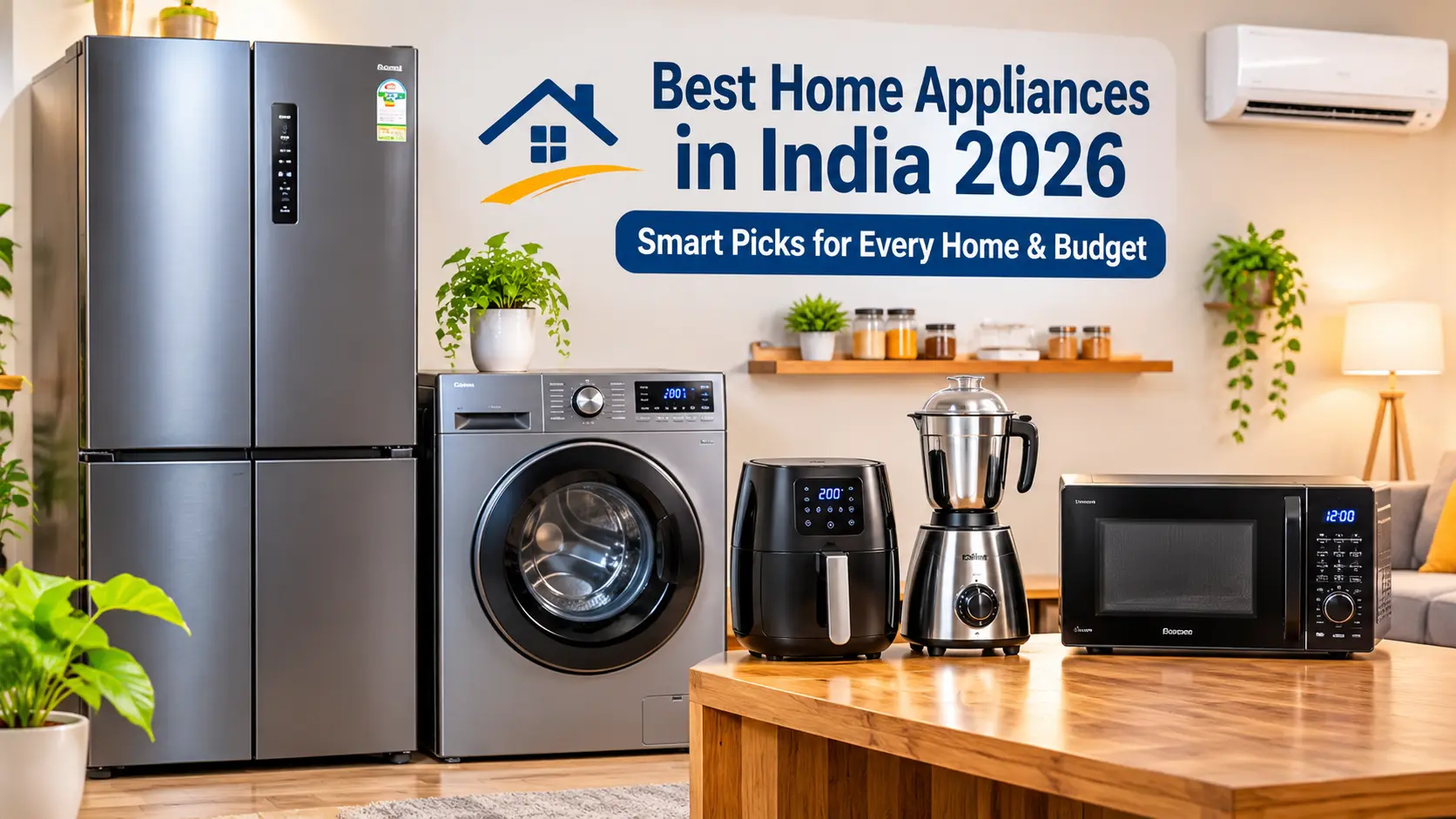
Looking for the best home appliances in India can be confusing because so many brands and models claim to offer the best features and value. In 2026, buyers also need to consider electricity consumption, BEE star ratings, limited space in modern homes, and local water conditions. Choosing the right appliance is not just about the purchase price. It is also about finding something that fits your daily needs, fits your budget, and works reliably for years.
Everything here is based on the needs of everyday Indian households. We begin with the appliances most homes need and then look at options for the kitchen, laundry, cooling, water and cleaning. For each appliance, we explain the important features to check, who it is suitable for and what to keep in mind before buying. We have not tested these appliances in a lab. Instead, we have used product details, official BEE information and other important buying factors to help you make a better choice.
What Are the Best Home Appliances to Buy in India?
For most Indian households, the best home appliances are an inverter refrigerator with a good BEE star rating, a 7 kg fully automatic washing machine, a water purifier matched to your water’s TDS, an inverter AC of the right tonnage and a 10 litre storage geyser. Choose by capacity, energy label, warranty and service support in your city, not by discounts. The sections below explain each pick, who it suits and what its limitations are.
What Is Sopinggo and How Does It Help You Choose?
Sopinggo helps Indian households find the best home appliance without going through hundreds of listings and confusing spec sheets. We bring the details that matter, such as size, features and running cost, into one place, so you can compare options and pick what fits your home and budget.
Here is what you will find on the site:
- Category pages: Organised pages for mixer grinders, air fryers, washing machines, refrigerators, microwave ovens, vacuum cleaners, water purifiers and air conditioners.
- Easy comparisons: A comparison tool that puts size, features, and energy use side by side, so you can judge appliances on what matters for your home.
We also share practical buying tips, product recommendations, and useful information about popular appliance brands to help Indian buyers compare options, understand important features, and choose products that offer good value for their money.
Which Home Appliances Should You Buy First?
If you are setting up a new home or upgrading on a limited budget, buy in this order: refrigerator, washing machine, water purifier (if your water needs it), cooling (fan, cooler or AC for your climate), geyser, and only then the smaller kitchen gadgets. The first four affect your daily routine and your monthly bill the most, so they deserve the biggest share of your money.
Here is a quick summary of what to look for in each category.
| Appliance | What to look for | Best suited for | Main drawback |
| Refrigerator | Inverter compressor, BEE star label, right litre capacity | Every home | Double door models cost more to buy and run |
| Washing machine | 7 kg fully automatic for 3 to 4 members | Small and medium families | Front load costs more, top load uses more water |
| Air conditioner | Inverter, correct tonnage, copper condenser | Bedrooms and small halls | High electricity use in peak summer |
| Water purifier | Technology matched to your water TDS | Homes with hard or brackish water | Filter changes and reject water in RO |
| Mixer grinder | 750 W motor, 3 jars, sturdy couplers | Daily Indian cooking | Noisy, jars wear out with heavy use |
| Air fryer | 4 to 5 litre basket, accurate temperature control | Snacks, reheating, light cooking | Small batch size |
| Microwave oven | Solo, grill or convection as per use | Reheating, baking | Needs microwave safe cookware |
| Geyser | Storage or instant, 5 star label, tank warranty | Bathrooms | Needs a safe electrical point and regular checks |
| Vacuum cleaner | Cordless, corded or robot as per floor type | Dust and pet hair | Battery life and filter cleaning |
How to Choose Home Appliances: 6 Checks Before You Pay
Before comparing models, run every appliance through the same checklist. It saves you from the most common regrets.
- Measure the space. Check the width, depth and height, and also the door swing, the lift or staircase and the gap needed for ventilation. A fridge that does not fit through your door is a very expensive mistake.
- Match capacity to your household. Bigger is not better. An oversized machine wastes electricity and water.
- Read the BEE label properly. Look at the star rating, the annual units consumed and the label validity period.
- Compare warranty and service. Check the product warranty, the separate warranty on the compressor, motor or tank, and whether the brand has a service centre in your city.
- Think about running costs. The cheaper appliance is not always the cheaper one to own. Add up the electricity, water, filter and servicing costs over five years.
- Check your power and water supply. Low voltage, frequent cuts and hard water change which model makes sense.
A simple way to estimate electricity cost: multiply the appliance wattage by the hours you use it, divide by 1,000 to get units, then multiply by your tariff. For illustration, a 1,000 watt appliance used for 2 hours a day consumes 2 units a day, and at an assumed ₹8 per unit that is about ₹16 a day. Your actual tariff depends on your state and slab, so check your latest bill.
Best Kitchen Appliances for Indian Homes
The kitchen is where most Indian households spend the bulk of their appliance budget, and it is also where marketing is loudest. Focus on what you will use every day.
Refrigerator: The One Appliance That Never Switches Off
A refrigerator runs 24 hours a day, so efficiency matters more here than anywhere else. As a rough rule of thumb, plan for 50 to 60 litres per person and add some buffer if you shop in bulk or host often. That is an editorial rule of thumb, not an official standard.
What to check:
- Inverter compressor: It adjusts its speed instead of switching fully on and off, which usually means steadier cooling and better efficiency.
- Frost free or direct cool: Direct cool single door models are cheaper and use less power, but you need to defrost them manually. Frost free double door models handle this automatically.
- Star rating: A higher star rating costs more upfront but pays back over the years because the fridge never stops running.
- Layout: Check whether the vegetable tray, door pockets and freezer size suit how you actually store food.
Most families of three or four can manage comfortably with a single door refrigerator. A double-door model is a better choice if you have enough kitchen space and regularly buy groceries in bulk. However, it usually costs more and may consume more electricity. Before choosing between a single door and a double door refrigerator, consider how much food your family stores and what refrigerator capacity is suitable for a small family.
Product
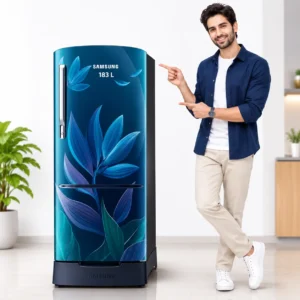
Samsung 183 L 4 Star Single Door Refrigerator
Suitable for individuals and small families looking for an energy-efficient refrigerator with reliable cooling and compact storage.
183 L Capacity • 4 Star Rating • 1 Year Warranty
Limitation: Double door fridges need more floor space and usually consume more electricity than a single door of the same age. In a small kitchen, a good single door model is often the more sensible buy.
Mixer Grinder: Look at the Motor and the Couplers
Indian cooking is hard on a mixer grinder. Wet masalas, dosa batter, dry spices and chutneys all put different loads on the motor. For a typical family, a 750 watt motor with three jars (a large wet jar, a dry jar and a chutney jar) covers most needs.
The parts that fail first are usually not the motor but the jar couplers and blades, so look for metal coupling, stainless steel jars with tight lids and an overload protection button. Check how easy it is to buy spare jars from the brand, because jars and gaskets do wear out.
Product
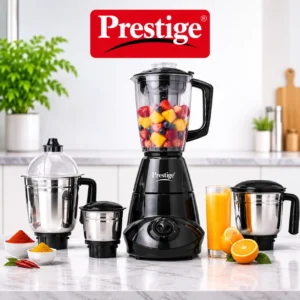
Prestige Iris 750W Mixer Grinder
Suitable for small to medium sized families looking for a versatile mixer grinder for grinding, blending, and juicing everyday ingredients.
750W Motor • 4 Jars • Stainless Steel Blades • 2-Year Warranty
Limitation: Higher wattage does not automatically mean better grinding. Blade design and jar shape matter just as much, and powerful models are louder.
Air Fryer: Great for Snacks, Not a Full Replacement for Your Kadhai
An air fryer circulates hot air to crisp food with much less oil. It works well for samosa, tikki, paneer, vegetables and reheating leftovers. It does not replace deep frying for every dish, and Indian batters like pakoda mixture need a different approach.
A 4 to 5 litre air fryer is generally suitable for a family of three to four. Look for a model with easy-to-use temperature controls, whether manual or digital, and a removable basket that is simple to clean. If you mainly plan to prepare samosas, tikkis, and other Indian snacks, choosing the best air fryer for Indian snacks depends more on cooking performance, basket capacity, and ease of use than on wattage or the number of preset programmes.
Limitation: Small baskets mean you cook in batches, which gets tiring when you are feeding six people.
Microwave Oven: Pick the Type That Matches Your Cooking
There are three types. A solo microwave heats and reheats, and it is the cheapest. A grill microwave adds a grilling element for tikkas and toasts. A convection microwave can also bake, so it suits cakes and cookies. If you only reheat food and make popcorn, a solo model is enough, and paying extra for convection will be wasted.
If you already own an air fryer, you may not need a convection model, because the two overlap for roasting and crisping.

Best Washing Machine for Indian Homes
For most families of three to four members, a 7 kg fully automatic washing machine is the safest choice, and couples can manage with 6 kg. Larger families, or homes that wash heavy bedsheets and curtains often, should look at 8 kg and above.
Top Load vs Front Load: Which Is Better?
- Top load: Usually cheaper, quicker to load and unload, and you can add clothes mid cycle on many models. It generally uses more water and can be rougher on delicate fabrics.
- Front load: Uses less water, cleans gently and often has better spin and wash programs. It costs more, takes longer per cycle and needs a firm, level floor to avoid vibration.
If you live in an area with water shortages or rely on tanker water, a front-load washing machine may help reduce water consumption over time. On the other hand, a top-load model is a practical choice if you prefer a lower purchase price and shorter wash cycles. When choosing the best washing machine for a small family, focus on capacity rather than extra features. A 7 kg model is a good starting point for many small families.
Product

Samsung 7 Kg 5 Star Top Load Washing Machine
Suitable for small to medium sized families looking for efficient washing, gentle fabric care, and convenient everyday operation.
7 Kg Capacity • 5 Star Rating • Digital Inverter Motor • 2 Year Warranty Care
Limitation: Hard water can build up scale inside the drum and heater. Clean the machine regularly and keep the drain filter free of lint.
Best Cooling and Heating Appliances
Which AC Should You Buy: Right Size and the New BEE Label
An air conditioner is probably the biggest electricity user in your home during summer, so a wrong choice shows up on every bill.
Tonnage: As a general rule of thumb, a 1 ton AC suits small rooms, a 1.5 ton AC suits medium rooms up to roughly 150 to 180 square feet, and a 2 ton unit is for large halls. Direct sunlight, top floor rooms, the number of people and the height of the ceiling can push you up a size, so treat this as a starting point only.
Inverter vs non inverter: An inverter compressor varies its speed and is usually more efficient for daily use. Fixed speed models can be cheaper to buy but cost more to run.
What is ISEER? ISEER stands for Indian Seasonal Energy Efficiency Ratio. It measures how much cooling an AC delivers for every unit of electricity it uses across India’s seasonal temperatures, so a higher ISEER means a more efficient AC. The BEE star rating is based on this number. You can read more about star labelling on the Bureau of Energy Efficiency website.
BEE star rating: The Bureau of Energy Efficiency tightened the star thresholds for air conditioners from January 2026. In practice, an AC that carried a 5 star label under the old norms may now rate as 4 star, even though its actual performance has not changed. This is why you should compare the ISEER value and the annual energy consumption printed on the label, and check the label validity period, instead of just counting stars. Sources do not agree on the exact ISEER cutoff for each star, so always rely on the figure printed on the specific model’s label or the official BEE source.
Other things to check: Copper condenser coil, anti corrosion coating if you live near the coast, a wide operating voltage range, and installation charges including the copper pipe and stand.
Product
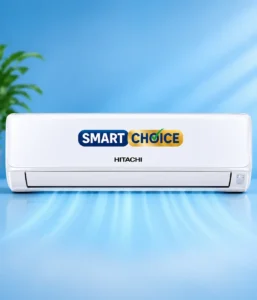
Hitachi 1 Ton 3 Star Inverter Split AC
Suitable for small rooms up to 100 sq. ft. looking for efficient cooling, flexible airflow, and reliable temperature control.
1 Ton Capacity • Inverter Technology • 4-Way Swing • 1 Year Warranty Care
Limitation: Even an efficient AC is expensive to run during long summers. If you only need cooling for two to three hours at night, a good fan or a cooler may be more economical.
Geyser: Storage or Instant?
A storage geyser heats water in advance and keeps it ready in an insulated tank, making it suitable for families who need hot water during the morning rush. An instant geyser heats water on demand as it flows through the unit, making it a practical choice for kitchens and small washbasins. For a small family, a 10-litre storage geyser with a 5-star BEE rating and a reliable tank warranty can be a suitable option. If you are shopping for the best geyser under ₹10,000, compare tank capacity, energy efficiency, safety features, and warranty before making a decision.
Safety matters here: make sure the geyser is installed with a proper earthed point, a pressure relief valve and a correctly rated wire. Do not buy purely on price, and do not skip a trained installer.
Best Appliances for Clean Water and a Clean Home
Which Water Purifier Is Right for Your Water?
There is no single best water purifier, because the right type depends on what is in your water.
- RO (Reverse Osmosis): Removes dissolved salts, so it suits borewell or tanker water with high TDS. TDS stands for total dissolved solids, and a common rule of thumb is that water above roughly 500 mg per litre needs RO. It produces reject water, and many models offer a TDS controller to keep some minerals.
- UV (Ultraviolet): Kills bacteria and viruses but does not remove dissolved salts, so it suits municipal supply with low TDS.
- UF (Ultrafiltration): Works without electricity and removes particles and bacteria, but does not handle dissolved salts or reliably handle viruses.
Drinking water quality limits, including TDS, are set in the Bureau of Indian Standards specification IS 10500.
Before buying, test your water TDS using a basic TDS meter or ask the brand for a free water test. Also check filter and membrane replacement costs, and whether the service team covers your area.
Product
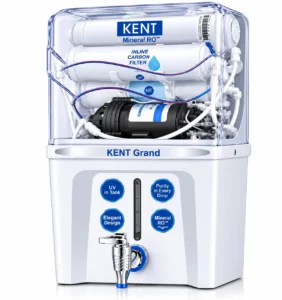
KENT Grand 7.5L RO Water Purifier
Suitable for families looking for purified drinking water from borewell, tanker, or municipal water sources.
7.5L Storage • 20 LPH Flow Rate • 1 Year Warranty Care
Limitation: Purifiers need regular servicing. A neglected filter can make water less safe than before.
Vacuum Cleaner: Pick by Your Floor and Your Time
If you have mostly tiled floors and a small home, a lightweight cordless stick vacuum is easy to store and use daily. If you have carpets, pets or a large home, a corded model with strong suction and a larger dust bin may be more practical. Robot vacuums save time but work best in homes with fewer obstacles and need regular brush and sensor cleaning.
Check battery life, dust bin size, filter type and how easily you can buy spare filters and brushes. These are the details that decide whether a vacuum stays in use or ends up in a cupboard.
Where to Spend More and Where to Save
Budget does not have to mean low quality. It means spending on the right things.
Spend more on: Refrigerator, AC, washing machine and geyser. These run for hours, last for years and directly affect your electricity bill and comfort. A higher star rating and a longer compressor or tank warranty are worth paying for.
Save on: Air fryers, sandwich makers, kettles and basic mixer grinders. If a smaller appliance breaks, replacing it is not a financial setback.
Consider instead of buying new: Check whether your existing appliance just needs servicing. A deep clean of an AC or a new filter in a purifier can make an older machine perform well again.
For current prices, check the live listings, because prices and offers on Amazon change often and may differ by seller and location.
Common Mistakes to Avoid When Buying Home Appliances
- Buying on discount alone: A big discount on an old model may mean you are buying outdated technology or an older BEE label.
- Ignoring the label year: Check the validity period on the energy label, particularly for ACs and refrigerators.
- Choosing too large a capacity: More litres or more kilograms means higher running cost, so match your actual family size.
- Forgetting installation and extras: AC installation, a geyser pipe kit or a fridge stabiliser can add to the final cost.
- Skipping service checks: Look at reviews for service response in your city, not just for the product.
- Trusting a single review: Compare specifications, warranty terms and multiple user experiences before deciding.
Start with a refrigerator, washing machine and water purifier (if your water needs one), followed by cooling and heating for your climate. These affect daily life and bills the most. Small kitchen gadgets can wait.
FAQs
What changed in the BEE star rating for ACs in 2026?
BEE raised the efficiency thresholds for air conditioners from January 2026, so it is now harder to earn the same star rating. A model that was 5 star earlier may now be labelled 4 star. Performance has not changed, so compare ISEER values and the label validity period.
Which water purifier is best for hard water?
For water with high TDS, such as many borewell and tanker supplies, RO purification is generally the more suitable option. For low TDS municipal water, UV or UF can work. Test your TDS first.
Which brand is best for home appliances in India?
No single brand is best for every appliance. Compare the warranty, the service network in your city and how easily you can get spare parts. A brand with quick local service is often better than one that is slightly cheaper.
Should I buy home appliances online or from a store?
Both work. Online shopping makes it easy to compare models and prices, while a store lets you check the size, build and demo in person. For large appliances, confirm the installation support, return policy and warranty registration before you pay, wherever you buy.
Which home appliances are most important to buy first in India?
Start with a refrigerator, washing machine and water purifier (if your water needs one), followed by cooling and heating for your climate. These affect daily life and bills the most. Small kitchen gadgets can wait.
How to Choose the Best Home Appliances for Your Home
The best home appliances in India are not the ones with the longest feature list. They are the ones that fit your space, your family size, your water and your electricity bill, and that come from a brand with real service support in your city. Begin with the refrigerator, washing machine and water purifier, read the BEE label carefully, and leave the smaller gadgets for later.
We will keep updating this guide as the Sopinggo collection grows, so check back before your next purchase.
Note: Prices, availability and specifications can change after publication. Please verify details on the product page before you buy.